
Across a landscape shaped by volcanoes, culture, and time
There is a different rhythm to Flores Island.
It isn’t found in a single destination, but somewhere along the road — where the air cools as you climb into the mountains, where villages appear quietly between hills, and where each turn reveals something you didn’t expect.
Flores is not a place you visit.
It is a place you move through — slowly, deliberately — allowing the journey to unfold.
What is a Flores Overland Journey?
A journey across Flores typically connects Labuan Bajo in the west to Kelimutu National Park in the east. It is less about ticking destinations off a list — and more about understanding the island through its landscapes, its people, and the quiet moments in between.
Best Time to Visit Flores
Flores can be explored year-round, but each season brings a different mood to the journey:
- April to June → lush green landscapes, waterfalls at their best, fewer travelers;
- July to August → dry season, clearer skies, but busier on the road;
- September to October → golden hills, dramatic light, ideal for photography;
- November to March → unpredictable heavy rain, quieter villages, more local atmosphere.
Unlike coastal destinations, timing here shapes the color and texture of the land — not access.
How to Travel Across Flores
- Private car + driver → most comfortable and flexible (IDR 750k – IDR 1250k per day);
- Private car + guide-driver → adds cultural depth and storytelling (IDR 1250k – IDR 2000k per day);
- Motorbike → freedom, but requires experience and stamina (IDR 75k – IDR 150k per day);
- Public transport (with Gunung Mas Travel) → not ideal; limited to main roads and misses key experiences (IDR 100k – IDR 200k from one regency to another).
How Many Days to Spend
- 3–4 days → fast-paced highlights;
- 5–7 days → ideal balance;
- 8+ days → deeper & slower pace exploration.
The Route (West to East)
1. Labuan Bajo → Wae Rebo → Ruteng
Leaving Labuan Bajo, the journey quickly turns inland.
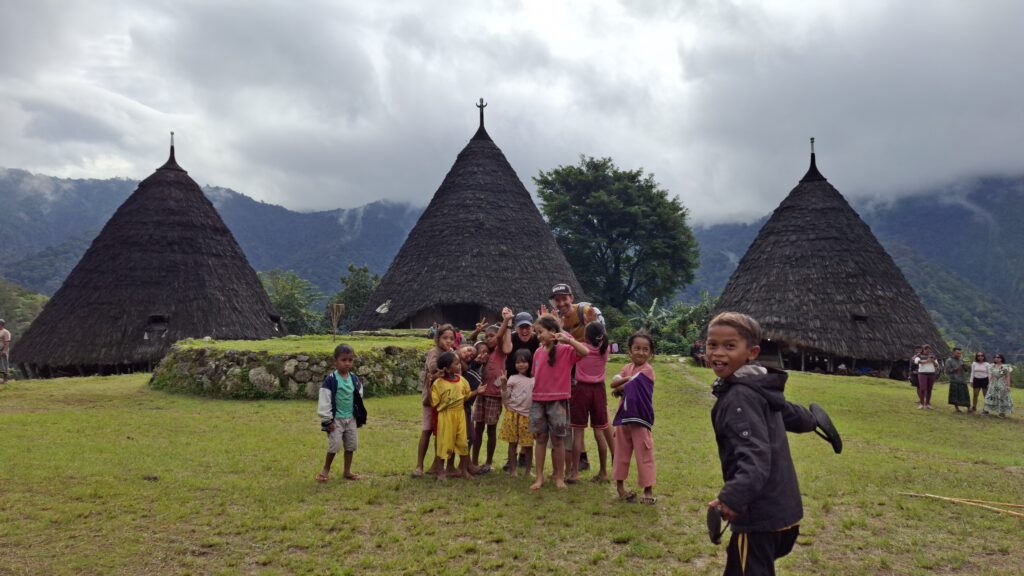
High in the mountains lies Wae Rebo Traditional Village — a remote village of cone-shaped houses, reached only by trekking. Spending a night here is less about comfort, and more about connection.
Continuing to Ruteng, the air cools, and the landscape softens.
Nearby, the spider-web patterns of Lingko Rice Fields stretch across the hills — a reflection of both tradition and ingenuity.
For those drawn to history, this region is also linked to Homo floresiensis, discovered in nearby caves — a reminder that Flores has always been a place of mystery.
Where to Eat in Ruteng
- Chacha Resto — good food, reliable, central, and comforting after long drives;
- Warung D’Joice — a surprising Balinese touch in the highlands;
- Spring Hill — one of the better Chinese food options in town;
2. Ruteng → Bajawa
The road east is long, winding, and deeply scenic.
A worthwhile stop along the way is Siquarra Resto — a simple but well-loved place to pause and eat.
Along this stretch, you can also visit quieter traditional villages like Belaraghi, or trek to Tololela for a more remote experience.
As the highlands of Flores cool and the mist rolls in, where you stay becomes part of the journey. Perched above the jungle, Manulalu Jungle Stays offers breathtaking views and peaceful mornings above the clouds, while nearby Heavens Door is perfect for a relaxed meal and sunset.
For a simpler stay, local homestays in Bajawa offer warmth, authenticity, and a closer connection to daily life. Whether you choose comfort or simplicity, Bajawa invites you to slow down and experience Flores at its most genuine.
3. Bajawa & Mount Inerie
Arriving in Bajawa, culture and landscape come together.
Villages like Bena Traditional Village continue to preserve ancestral ways of life.
Above it all rises Mount Inerie — a near-perfect volcanic cone. The hike is steep and demanding, but reaching the summit at sunrise is deeply rewarding.
After the climb, soaking in the natural pools of Malanage Hot Spring is almost essential. Before leaving Bajawa, a short stop at Watu Nari Wowo offers a final look back at Mount Inerie — a quiet moment to take in what you’ve just experienced.
Where to Eat in Bajawa
- Taman Kartini Restaurant — local flavors in a relaxed setting
- Milonari Restaurant — simple and satisfying
- If staying at Manulalu Jungle, the Heavens Door Restaurant offers both good food and unforgettable views
4. Bajawa → Riung
Heading north, the atmosphere shifts once again.
Riung 17 Islands Marine Park is one of Flores’ quietest treasures — calm waters, empty beaches, and a slower, more unhurried pace of life. Here, the experience feels more personal, more local.
5. Riung → Ende → Moni
Back on the main route, the road leads toward Ende.
A stop at Wolopaku Coffee Plantation reveals a different side of Flores — where people truly understand their craft, and coffee is treated with care and knowledge.
For those with more time, detours to Nggela Village or Koka Beach add even more depth — from cultural immersion to untouched coastline.
6. Moni & Kelimutu
Back on the main route, the road leads toward Ende. For those with more time, detours to Nggela Village or Koka Beach add even more depth — from cultural immersion to untouched coastline.
Where to Stay Along the Way
Ruteng
- Chacha Homestay
- Sun Rice Homestay
- Spring Hill Hotel
Bajawa
- Manulalu Jungle
- Local homestays in Bajawa
Ende / Moni
- Gecko Homestay
- Farila Guesthouse
Riung
- Riung Guesthouse
- Island camping for a more adventurous experience
Packing Advice
Flores rewards those who come prepared — not with luxury, but with variety.
Bring:
- Light, breathable clothing for hot coastal areas;
- A warm layer for cooler highlands (Ruteng, Bajawa, Moni);
- Proper shoes for trekking (Wae Rebo, Inerie, Kelimutu);
- Rain jacket (especially November–March);
- Flip flop and flash light;
- Reef-safe sunscreen and insect repellent;
- Small backpack for daily essentials;
Comfort here comes from preparation, not excess.
Practical Tips
- Don’t hesitate to ask, Flores people are open and kind;
- Distances are long — start early each day;
- Roads are winding — travel takes longer than expected;
- Cash is essential outside main towns;
- Internet can be limited — embrace being offline;
- Respect local customs, especially in traditional villages.
Final Thoughts
A journey across Flores Island is not defined by a single moment.
It is the accumulation of many — the early mornings, the long drives, the quiet conversations, the landscapes that shift without warning.
Flores does not try to impress you.
It simply reveals itself — slowly, honestly — and stays with you long after you leave.
Tips for a Responsible Visit
- Do not touch or feed the wildlife.
- Do not step on coral while snorkeling.
- Minimize single-use plastic during your visit. Always ask your operator to provide bigger water gallon rather than small bottles of water.
- Take all rubbish back with you.
- Keep noise levels low around wildlife.
- Choose tour operators and guides that follow responsible tourism practices.
Planning a Flores overland journey is about more than logistics — it’s about creating something that feels right. If you’re looking for a journey that is seamless, thoughtful, and truly personal, I'm here to help you design it.
Talk to A Local Guide
Kind Regards,
Rio - Beta Komodo